

Did damage ruin the value of my art? Not necessarily. Damage can reduce the value of an artwork, but it does not automatically make the work worthless—and there is no standard percentage by which all damaged art decreases in value.
The effect of damage depends on the particular artwork, what was damaged, how visible or significant the damage is, whether it can be successfully conserved, and how buyers in that specific market respond to works with similar condition issues.
In other words, the better question is not simply “Is it damaged?” but “What does this particular damage mean for this particular artwork?”
No. Some damage may have little or no measurable effect on market value after appropriate conservation. Other damage can result in a significant loss in value.
Condition is only one component of value. An appraiser also considers the artist or maker, rarity, quality, medium, subject, provenance, market demand, comparable sales and the expectations of buyers in that collecting category.
A rare and highly desirable artwork may retain substantial value despite serious condition issues. Conversely, damage to a more readily available work may make buyers choose an undamaged example instead.
There is no universal formula.
A 10%, 25% or 50% deduction may sound convenient, but loss in value cannot be determined responsibly by applying the same percentage to every damaged artwork.
The appropriate analysis compares the artwork and its market before and after the damage or treatment. When possible, an appraiser looks for sales of comparable works in differing conditions and considers how the market actually responds to the type of damage involved.
This is often referred to as loss in value or diminution in value: the difference between the value of the artwork before the damage and its value after appropriate conservation or restoration.
Very much.
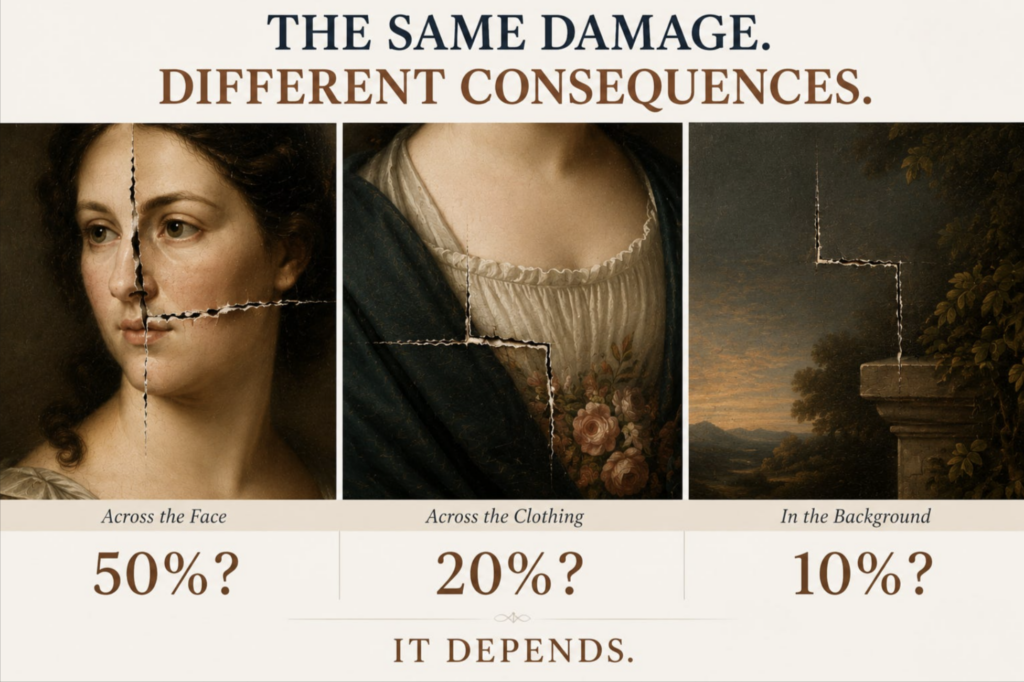
Damage in a visually or artistically important area can have a different effect from comparable damage in a less significant area.
For example, damage crossing the face of a portrait may be considerably more consequential than damage of the same physical size in an unobtrusive area of the background. Similarly, damage affecting a signature, inscription, original surface, identifying mark or important design element may carry consequences beyond the physical size of the loss.
This is one reason percentage formulas can be misleading: two areas of identical physical damage do not necessarily represent identical losses in value.
Sometimes—but restoration does not automatically reduce value.
Professional conservation may stabilize an artwork, improve its appearance and preserve it for the future. In many collecting markets, appropriate and well-documented conservation is accepted and expected.
The effect on value depends on what treatment was necessary, how much original material remains, whether important elements were altered or replaced, the quality and reversibility of the work, and how the relevant market treats comparable restored objects.
Poor, excessive or undocumented restoration can create a different problem. An inappropriate repair may itself become a condition issue and can sometimes be more damaging to market confidence than the original accident.
Absolutely.
Many important paintings, works on paper, sculptures, pieces of furniture, decorative arts and other collectible objects have undergone conservation during their histories and remain highly valuable.
The important questions are what happened, what treatment was performed, whether it was appropriate, how much original material survives, and how that history affects the particular market for the object.
Restoration history should therefore be evaluated—not treated automatically as proof that an artwork has lost its value.
Do not begin with the assumption that every damaged artwork should immediately be restored.
The first step is usually to document the condition and obtain appropriate professional advice. A qualified conservator can determine whether treatment is necessary, what can realistically be achieved, what risks are involved and what the treatment may cost.
If the artwork is financially significant, an appraisal perspective may also be useful before treatment. In some situations, the decision to restore can affect an insurance claim, potential sale, loss-in-value analysis or the evidence available to establish the artwork’s pre-loss condition.
Before cleaning, gluing, retouching or attempting a repair yourself, photograph the damage and preserve any detached fragments or components.
An appraisal may be appropriate when the financial effect of the damage matters.
This can include an insurance claim, a potential sale, a dispute, an estate matter, or simply a collector trying to decide whether a costly conservation treatment makes economic sense.
A conservator and an appraiser answer different questions. The conservator addresses the physical object: what happened, whether it can be treated and how. The appraiser addresses the market: what the artwork was worth, what it may be worth after treatment and whether the damage has resulted in a measurable loss in value.
For complex claims, both perspectives may be necessary.
Collectors understandably want a number: How much value did the damage take away?
But a percentage only becomes meaningful when it is supported by the particular artwork, the location and nature of the damage, the quality of treatment and evidence from the relevant market.
Why might damage to the face of a portrait have a very different effect from damage in the background? When is a percentage deduction useful—and when does it create a false sense of precision?
Those questions are explored in greater depth in Jennifer Garland Ross’s Currencies of Value article, “The Damage Is Obvious. The Loss in Value Isn’t.”
Art Peritus provides independent appraisal and loss-in-value analysis for fine art, decorative art and other valuable personal property and luxury assets. In damage and insurance matters, our role is to translate condition, conservation findings and market evidence into a clear, supportable valuation analysis.
###
Jennifer Garland Ross, AAA, is a nationally recognized fine art appraiser and lecturer specializing in fine art appraisal, valuation standards, appraisal education, and art insurance claims. She is the founder of Art Peritus, a fine art appraisal and luxury asset appraisal firm providing USPAP-compliant appraisals, expert valuations, and consulting services for collectors, estates, insurers, attorneys, fiduciaries, and family offices. Art Peritus provides independent valuation expertise across fine art, decorative arts, and more than 70 categories of valuable personal property and luxury assets.
Follow her:
Substack: https://jgarlandross.substack.com/
LinkedIn: https://www.linkedin.com/in/jennifer-garla…
Instagram: https://www.instagram.com/jgarlandross/
Art Peritus: https://artperitus.com/